So Very Sociable: Saskatchewan Sports Days & Community Picnics
Settling in Saskatchewan was no easy feat. The prairie way of life was isolating, especially during the earliest days of settlement when long distance communication was practically nonexistent. That feeling of isolation persisted well into the twentieth century, particularly for those who had limited access to a train station, post offices, or new technology like a telephone.
Socializing with others contributed greatly to the positive well-being of the early settler. Efforts were made to establish annual events to gather neighbouring communities and districts together for quality social time. A popular event was the annual Sports Day or Community Picnic, a simple gathering meant to bring people together, which naturally included dining, playing (and therefore competing!), and making memories. The atmosphere was one of fellowship, good will, cooperation, and hope for the future.
So Very Sociable: Saskatchewan Sports Days & Community Picnics uses archival records preserved at the Provincial Archives of Saskatchewan to emphasize the significance of sports days and community picnics in Saskatchewan’s earlier days.

Pioneer Questionnaire No. 5: Pioneer Recreation and Social Life
In the early 1950s, the Provincial Archives of Saskatchewan distributed a series of Pioneer Questionnaires to collect memories and information about the earliest days of the Province of Saskatchewan. Eleven different questionnaires were developed. No. 5 Pioneer Recreation and Social Life sought information about neighbourly visiting and parties, organizations and meetings, children’s games, reading, musical entertainment, hobbies and special interests, as well as sports and picnics. This latter section specifically queried the participants about annual sports days and community picnics.
Much of the text in So Very Sociable: Saskatchewan Sports Days & Community Picnics was selected from or informed by the approximately 300 responses to the Pioneer Recreation and Social Life questionnaire, including Margaret Gertrude (Maveety) Smith’s.
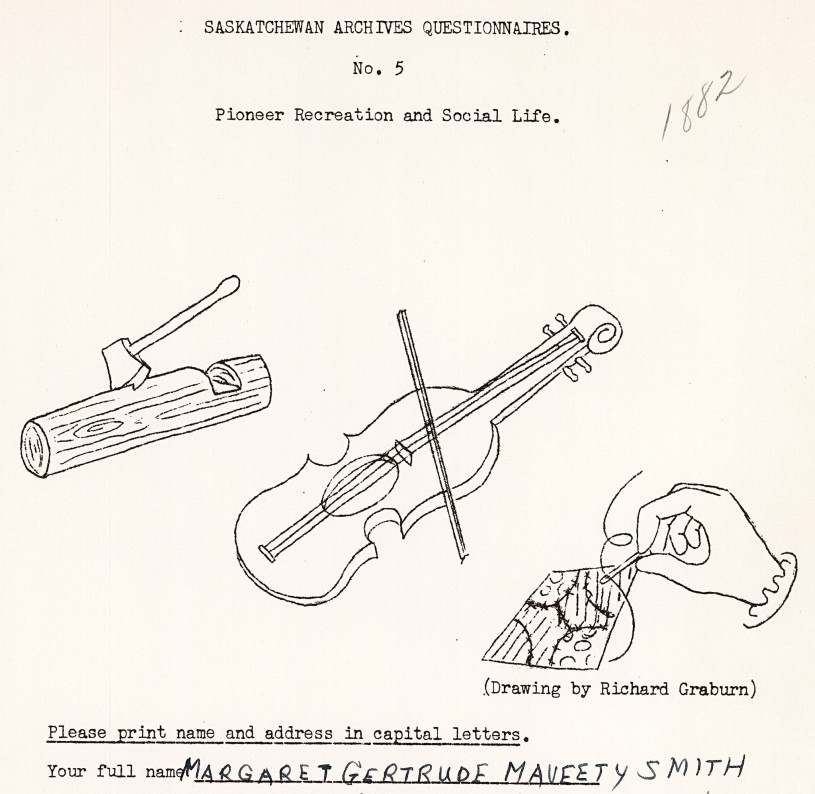
No. 5 Pioneer Recreation and Social Life questionnaire submitted by Margaret Gertrude (Maveety) Smith. PAS File (S)X 2.1890.
According to Margaret, who settled in the Prince Albert area in 1882, her family did “not often” visit neighbours.

[not often]
Therefore, it’s no surprise that the community picnic “seemed so very sociable” upon reflection decades later.
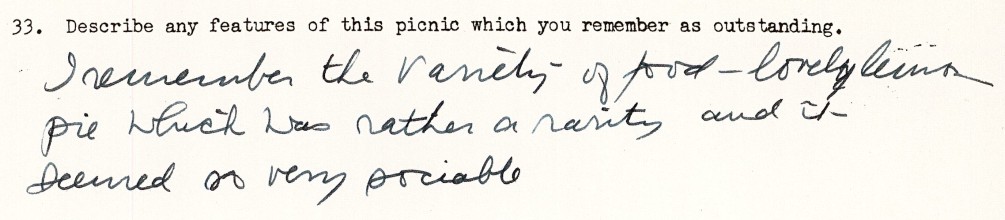
[I remember the variety of food - lovely lemon pie which was rather a rarity and it seemed so very sociable]
Organizers & Attendees
Many years ago, Dominion Day was one of the most popular days to host a sports day or community picnic. Another common option was May 24, Queen Victoria’s birthday.
Sports days and community picnics were organized by community members, often under the umbrella of a club or society. Common organizers included Ladies’ Aid Societies, the Orangemen, church committees, and even school children.

Orangemen's picnic at MacDowall in 1922. PAS Photo R-D570.

Dismantling a sports day camp held at the Hudson's Bay Company store at Lac La Ronge. PAS Photo R-A6959.
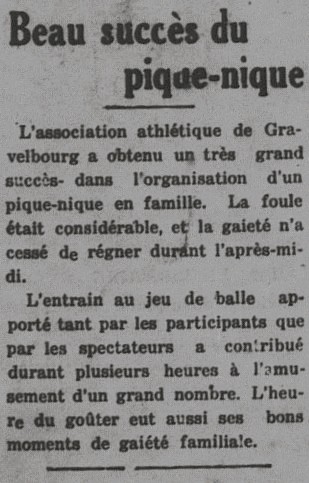
"Beau succès du pique-nique" published in
L'Étoile de Gravelbourg on May 17, 1934.
PAS File NP 207. Translation.
And who were the attendees? According to questionnaire responses: "whoever wished to come".

[whoever wished to come]
PAS File (S)X2.1932.
Location & Transportation
Sports days and community picnics took place wherever there was sufficient space, such as at designated sports grounds or next to churches or halls.

Picnic held likely in the Cypress Hills area circa 1905. PAS Photo R-A3350.

The "picnic train" at the Broadview train station circa early 1900s. PAS Photo R-A18803.

Baseball game at Carlyle Lake sports day at an unknown date. PAS Photo R-A27776.
Modes of transportation to-and-from the event would have changed over time. Interestingly, several sources attribute the downfall of sports days and community picnics to the automobile. Automobiles allowed people to travel further, and faster. Therefore, those with access to an automobile could choose which events they preferred to attend, which often were the biggest and grandest. Smaller communities’ events eventually folded due to lack of participation.
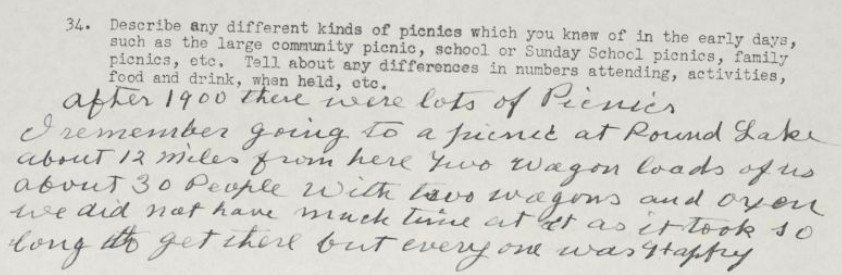
[After 1900 there were lots of picnics I remember going to a picnic at Round Lake about 12 miles from here two wagon loads of us about 30 people with two wagons and oxen we did not have much time at it as it took so long to get there but everyone was happy]
PAS File (S)X 2.1886.
Food & Drink
Have you been wondering what food and drink were typically consumed at sports days and community picnics?
Attendees brought their own food to the event. Although potlucks were not unheard of, most ate their own provisions and relished in time spent eating with new and old friends. If wood was available, makeshift tables and benches were constructed for seating. Picnic blankets, of course, also sufficed.

Refreshment booth topped with poplar boughs at a sports day held south of Grenfell circa 1912. PAS Photo R-A7396.

Sports days tea tent sponsored by St. George's Women's Auxiliary Project of Ituna in 1915. PAS Photo R-A17999.
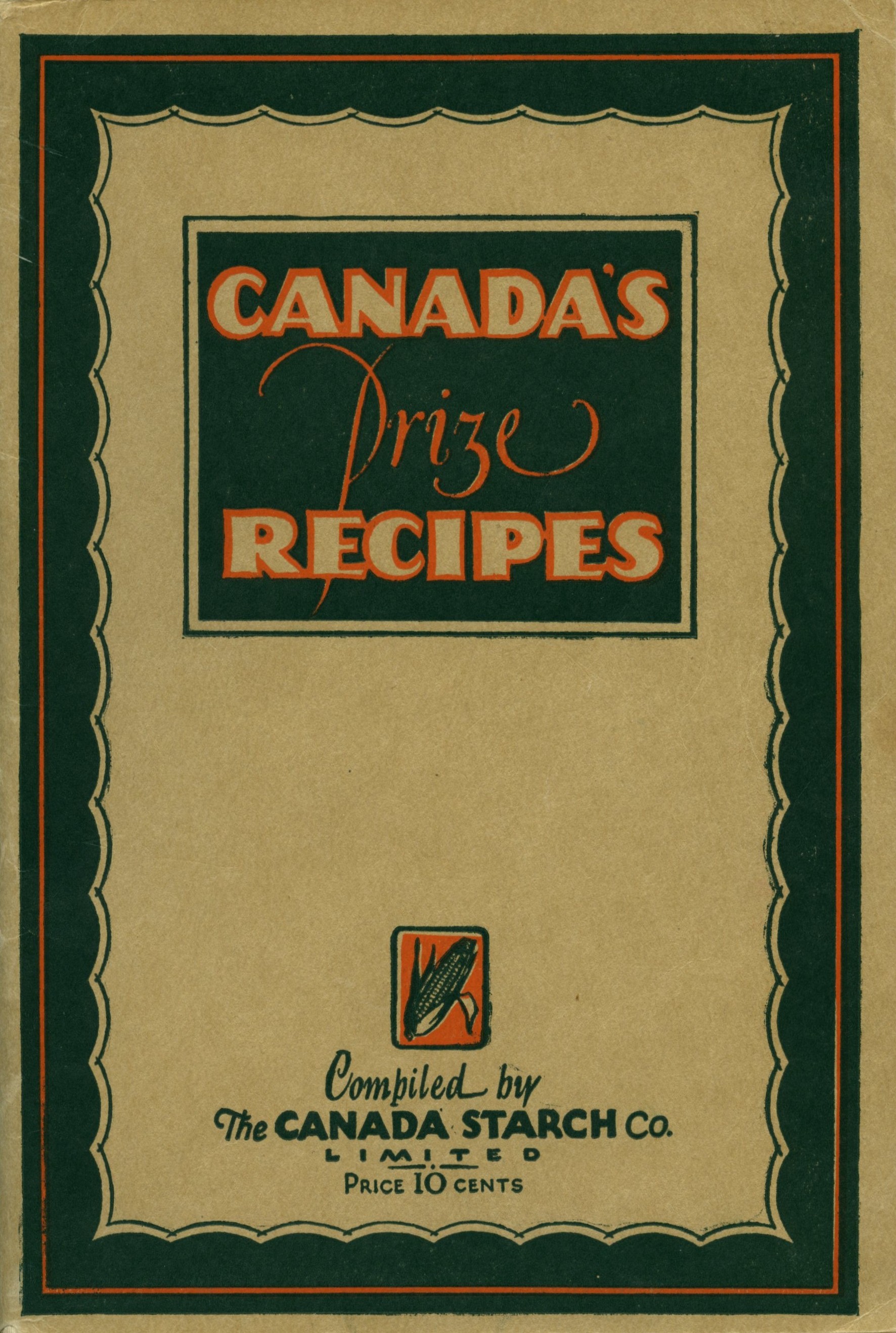
Canada's Prize Recipes by the Canada Starch Co. Ltd. published
in 1930. PAS Item PI-1049.
Fried chicken, cake, tea, and lemonade were popular menu items.
Sometimes snacks and refreshments were served as a fundraiser.

[bread, Johnnie cake, rice pudding, friend chicken (prairie) pork, hard tack-round hard biscuits 1 in. thick 5 in. diameter]
PAS File (S)X 2.1892.

[sandwiches, cake, tea, lemonade]
PAS File (S)X 2.1933.
Interested in old-fashioned Johnny cake and lemonade recipes? Check out our culinary experiment!
Sports
The sports played at sports days were not necessarily the sports that would be expected to be played today.
Some of the most popular events were races: foot races, horse races, obstacle courses, and track and field-type events.
But what was the most popular event? Why baseball, of course!

Baseball game at Carlyle Lake sports day at an unknown date. PAS Photo R-B7998.

Boys' foot race at a sports day held in the St. Luke district near Whitewood in 1943. PAS Photo R-A6212(1).

Relay race at a sports day held at Royal Canadian Air Force Service Flying Training School (SFTS) Number 11 located near Yorkton in 1942. PAS Photo R-A7114(1).

A large swing at a sports day held in Milestone in 1911. PAS Photo R-B9273(2).

Pole vaulting at a sports day held at Royal Canadian Air Force Service Flying Training School (SFTS) Number 11 located near Yorkton in 1942. PAS Photo R-A7114(2).

Ladies' tug o' war at a picnic held in Davis in 1917. PAS Photo R-A4417.

Barrel obstacle course at a picnic held near Coalfields in 1904. PAS Photo R-A20759(1).

Moosomin Brass Band performing from a horse-drawn wagon for a Calithumpian parade in Moosomin in 1897. PAS Photo R-A19074.
Reminiscences also include mention of tug o’ war, swinging, catching the greasy pig, and parades.
Efforts were made to include all attendees: events for men and women, both young and old.
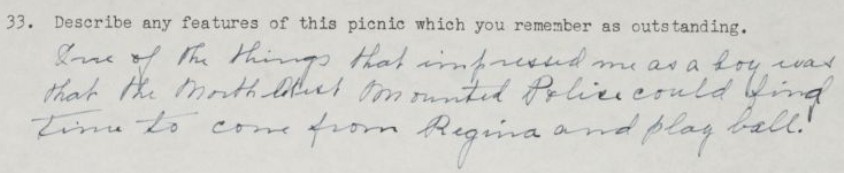
[Some of the things that impressed me as a boy was that the North West Mounted Police could find time to come from Regina and play ball!]
PAS File (S)X 2.1935.
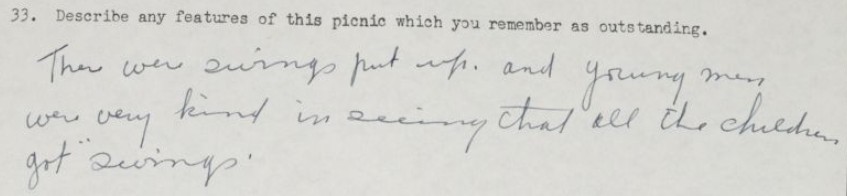
[There were swings put up and young men were very kind in seeing that all the children got "swings"]
PAS File (S)X 2.1914.

[W.M. Crawford, an Indian Head batchelor then had built a small steamboat so most of us had a ride on the lake.]
PAS File (S)X 2.1909.
Interested in learning more about the Pioneer Questionnaires that informed So Very Sociable: Saskatchewan Sports Days & Community Picnics? Examples of the eleven questionnaires are available via the Pioneer Questionnaires section of our website.
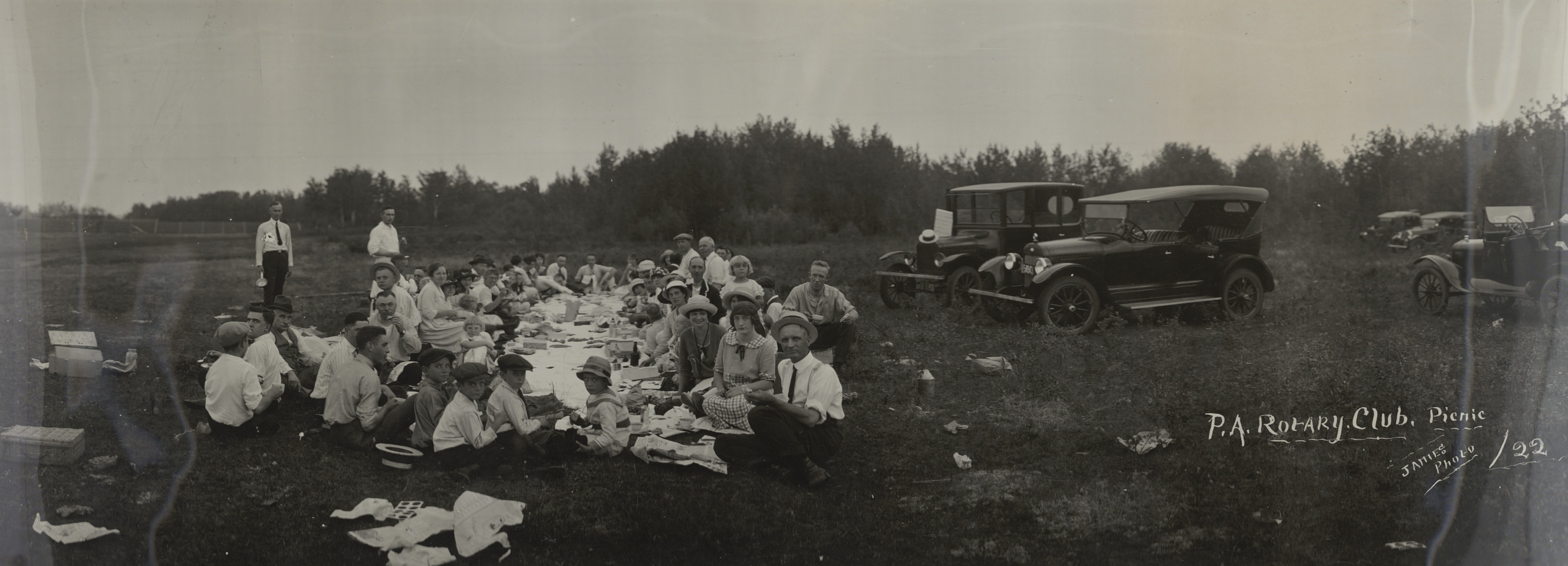
Prince Albert Rotary Club picnic in 1922. PAS Photo R-D483(2).